Digital Capability
Digital Capability Overview
A governed enablement layer for workflow, evidence, supervised automation and operator-facing control where trade operations need more than generic software language.
Why this legacy route still matters
Existing links and references still point to this route, so CSA Nexus keeps it as a stable public capability statement rather than letting the digital layer collapse into a vague redirect. The fuller narrative lives under the dedicated Digital Platform and Labs & Use Cases surfaces, but this page still needs to explain the commercial and operating logic clearly enough for a reader who lands here first.
The digital proposition is framed as governed infrastructure: modular platform logic, supervised automation, evidence preservation, workflow visibility and maturity-labelled communication. It is not presented as a generic software brochure, and it is not positioned as an unqualified product commercialisation claim detached from the work that currently gives it value.
In practice, clients buy this layer when they want customs, documentary governance, controls, accounting adjacency or trade operations to stop depending on brittle email chains, opaque spreadsheets and repeated manual reconstruction of the same decision trail.

The digital question starts in the operating chain, not in the UI.
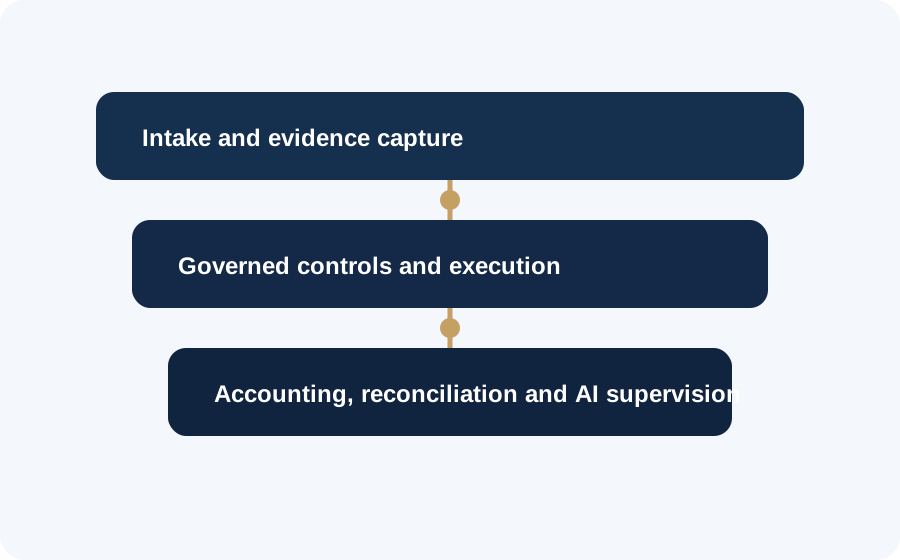
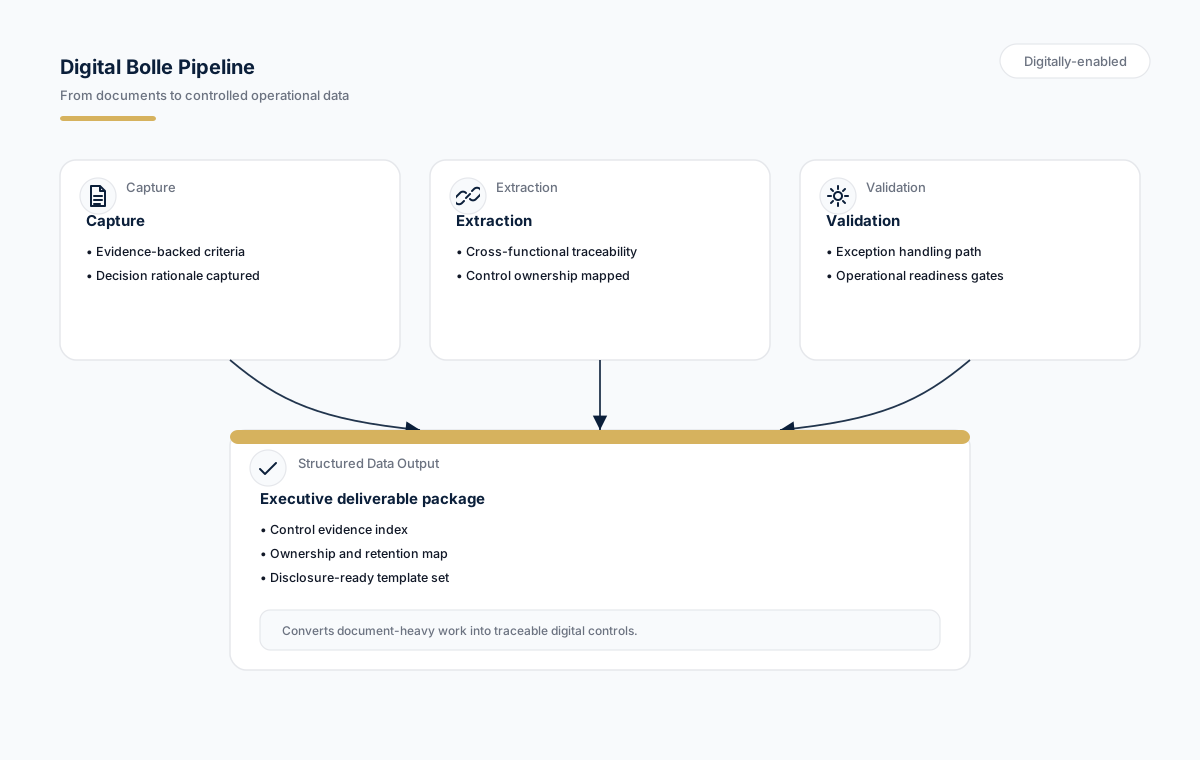
We use the digital layer to support intake, evidence packs, routing, decision memory, operator visibility and supervised automation around real trade work.
Diagnostic and workflow design
Process mapping, pain-point capture, role design and control-point identification before any workflow or automation layer is prescribed.
Evidence and execution support
Acquisition, OCR, routing, task assignment and evidence-pack generation designed around auditability, operator clarity and review gates.
Supervised automation
AI support is surfaced only where provenance, review, entitlement boundaries and explainability remain visible to the operator and the business owner.
| Digital layer | What it changes in practice | Why it has commercial value |
|---|---|---|
| Document intake and evidence capture | Turns attachments, OCR output and supporting documents into a traceable file rather than a mailbox trail that has to be rebuilt every time the case escalates. | Reduces loss of case memory, duplicate requests and the hidden cost of reassembling evidence when customs, finance or management need the same answer again. |
| Workflow and ownership routing | Makes it clearer which user, group or company scope owns the next step, the exception, the control review or the escalation. | Improves operational continuity and reduces the friction created when customs, operations, finance and compliance each believe the problem is sitting somewhere else. |
| Operator-facing dashboards | Surfaces backlog, recurring exceptions, evidence gaps, control timing and corridor pressure in a form that can support day-to-day decisions. | Creates management visibility without needing a heavyweight transformation program before the team can start improving the flow. |
| Supervised AI and knowledge support | Adds retrieval, drafting and structured assistance only where the provenance chain remains visible and a human reviewer keeps the release decision. | Clients gain leverage on repetitive work without turning compliance-sensitive activity into an opaque automation claim. |

The digital layer is there to support real operator pressure.
Border deadlines, document gaps, recurring checks, exception aging and customs-accounting handoffs are the situations that justify the capability, not software theatre.
The operating system still needs explainability, boundaries and retained judgment.
Licensing, entitlements, audit memory and evidence retention are treated as first-class design questions because the commercial model depends on modular, defensible activation.
How this capability is sold responsibly
CSA Nexus does not present the digital layer as a detached product miracle. It is sold as an enablement component inside mandates that need stronger intake, cleaner evidence handling, better workflow visibility or supervised automation around legally sensitive operations.
That positioning is deliberate: it keeps the public message aligned with what is already useful, while leaving room for the dedicated digital surfaces to describe future-ready platform logic in more detail.
Where it fits in the service architecture
The digital layer can enter as part of a diagnostic, a bounded advisory project, retained support or a later enablement step once the client has clarified the control model. The site now makes that commercial logic visible instead of implying that digital means a separate, all-or-nothing software sale.
This also keeps the narrative consistent with the wider public site: senior-led advisory first, enabling infrastructure where it materially reduces friction, rework and control opacity.